
Somatry / Find your next investigation
Deduction Puzzle Games: Evidence Before Answers
A deduction should survive a check. Somatry’s puzzle is to connect written records into an explanation, with enough support that an answer is more than a plausible guess.
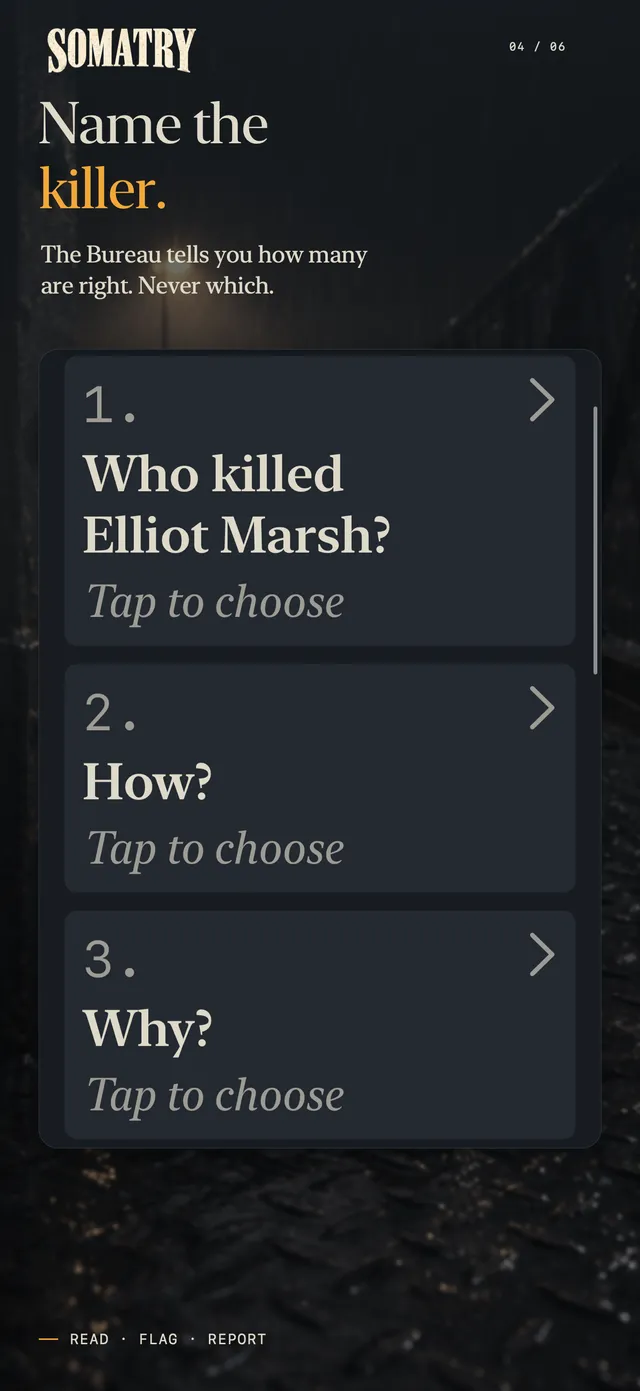
A logic mystery made of claims
Somatry is a deduction puzzle game for iOS and Android. Its fifty fictional cold cases ask for an explanation of who, how, why and when. The material is a case file: messages, documents, logs and accounts that can be read and compared. The challenge is not simply to spot a suspicious sentence. It is to determine which claims follow from the available information and how those claims fit together.
That distinction gives the puzzle its form. A possibility may explain one detail beautifully while failing to account for another. A supported deduction needs to survive the whole relevant record. When a theory becomes attractive, give its most difficult detail another look. If it only works after an unsupported assumption is added, the file has not yet supplied the connection the report needs.
Two records should support an answer
The design seals each answer with two records. That means the conclusion has support beyond a single suggestive line. The useful work is to identify how the records connect. One can establish an action; another can connect it to the relevant person or time. Their relationship turns a suspicion into an explanation that can be checked without asking the player to make a lucky leap.
Two records are not automatically two independent confirmations. A transcript repeating a message is still drawing on that message. Read the origin of the information as well as its wording. The guide on independent corroboration explains the distinction with fictional teaching examples. It helps separate a chain of repeated claims from a pair of records that establish different necessary parts of the same conclusion.
The website demo isolates one connection
The thirty-second demo uses a shop's empty cash box, a clerk's statement and three records. It asks for the record that breaks the statement. A message preserves the clerk's own account, a key register connects a key to a person, and a door log gives the later use that makes those records matter together. Nothing from a playable case is needed to follow the example.
The small size is deliberate. It leaves the difference between a claim and a contradiction visible. Flagging the message alone returns the reasoning to the source of the claim. Flagging the register alone leaves the timing question open. The correct choice works because the surrounding records provide the connection. A full case asks for more relationships, but the habit is the same: state what each source contributes before joining them.
Blanks make a theory specific
A report blank asks for an answer precise enough to test. The report's central fields concern the responsible person, the method, the motive and the relevant moment. They stop a theory from remaining a vague impression that someone had both a reason and an opportunity. Each field needs its own support, and the fields must describe a single account rather than several incompatible possibilities.
Keep those requirements separate while checking them. Evidence for motive does not prove access. A timeline that permits a method does not prove it was used. An object being present does not by itself place its owner beside it. The linked guide on objects and owners examines that last distinction, while the guide on report consistency checks whether the finished fields can all be true together.
Difficulty is a matter of structure
The case tiers are File, Case, Major and Finale. The collection progresses through different scales of investigation, while keeping the same three actions: Read, Flag and Report. A larger case can require more relationships to be held together, but the basic standard remains stable. The answer must come from the supplied clues. The game does not require outside research to repair a missing explanation.
That fairness does not mean every line has equal weight. Some details supply context, some preserve a speaker's account and some establish a constraint. A useful reading asks what function a detail can serve before assigning it a report field. The guide on document purpose develops this approach: a roster, receipt or log was made to record something particular, and its original purpose affects what it can prove.
A submission checks the whole account
When a report is submitted, the Bureau returns how many answers are correct, never which ones. Feedback therefore constrains the account as a whole without pointing to a field to cycle through. Reread the least supported answer first. Check the exact wording, compare the relevant sources and ask whether a date belongs to the event, the message about it or the later filing of the record.
There is a difference between revising a theory and merely replacing an answer. A revision changes a claim because a source gives a reason to change it. Keep the source in view so that the next submission represents a better account, not just another combination. Each case includes three Consults, never for sale, for moments when that comparison has become difficult to follow.
Fair play starts with the free case
Case 1 is a complete free investigation. It provides a way to test the reading, flagging and reporting interface before purchasing the rest of the base collection. The Coldmere County purchase unlocks forty-nine further cases across three fictional cities. There are no ads or subscriptions, and the store shows the local price before purchase. Every case can be solved with its supplied clues.
The public case pages introduce premises, settings and tiers. They contain no report answers, evidence inventories or closing scenes. Use them to choose an introduction, then keep the actual deduction inside the game. The murder mystery page focuses on the report's narrative explanation; the cold-case page focuses on old files and restored records. This page concerns the standard that connects them: an answer should remain supportable when its sources are checked.
Questions about deduction
Is guessing required to solve a case?
No. Every case is solvable with its supplied clues, and the design supports each answer with two records.
Does feedback reveal which answer is wrong?
No. A submission returns the number of correct answers, never their identities.
Are the website examples case solutions?
No. The demo and teaching examples are invented separately from the fifty playable cases.
Read. Flag. Report.
Try the thirty-second mystery, then start with the complete free first case. Released October 31, 2026.


Opening files
Introductions only. Later briefs may refer to earlier cases.
- Case 02 · fileSix BellsAshdown, ColdmereCold for 6 years, 5 months
- Case 06 · caseReproducibleThe Quad, ColdmereCold for 8 years, 2 months
- Case 08 · majorThe Winter PierGrayhaven Pier, ColdmereCold for 7 years, 1 month