
Somatry / Find your next investigation
Cold Case Games: Reopen the Written Record
A cold file is a record left unfinished. Somatry reopens fifty fictional investigations by returning to the phones, documents and overlooked entries that can still be read.
What makes a case cold
The passage of time changes an investigation without changing the event it is trying to explain. A phone may have remained locked in property. A record may have been copied into an archive nobody reopened. An early account may have become the accepted sequence because the original team had nothing stronger to compare against it. A cold case begins with that distance between the surviving file and the explanation it never reached.
Somatry gives each case a stated cold period and an opening brief. Read them as orientation. The elapsed years explain why a record is being revisited; they are not a measure of playing time or a promise about difficulty. All cases and places are invented. The game uses the structure of an old investigation to make reading and reconsideration central to the mystery, without presenting the file as a historical event.
Archived phones preserve more than a final message
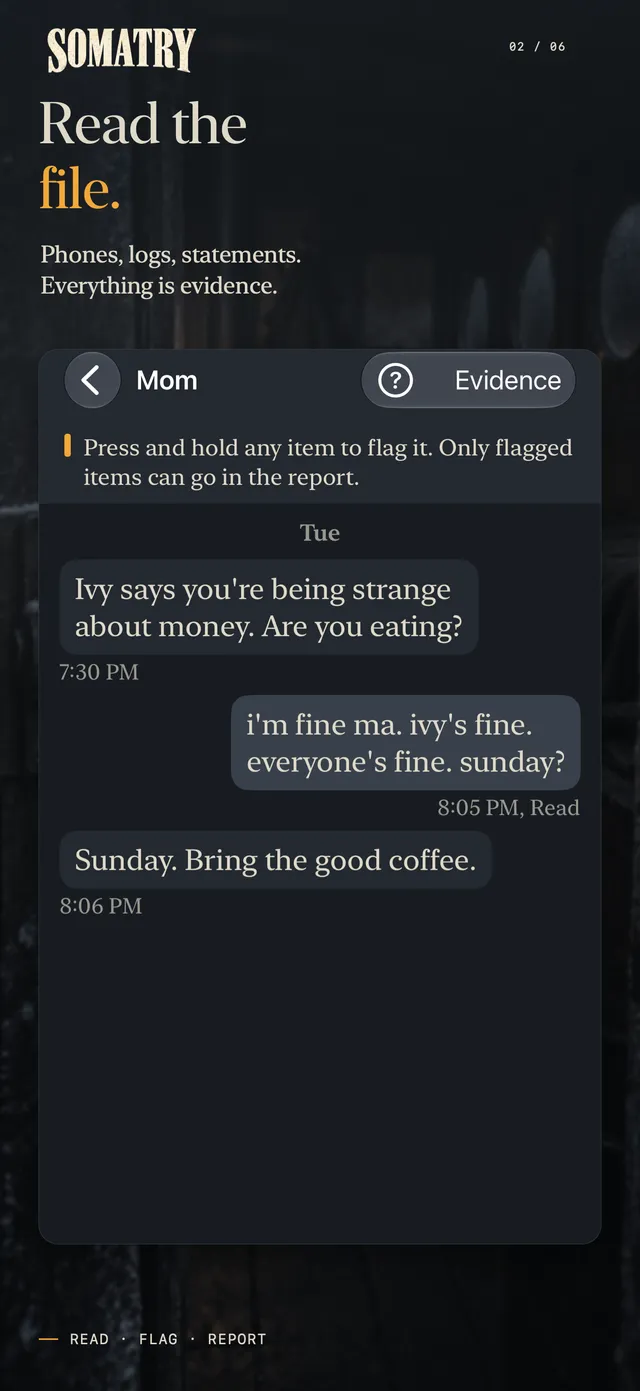
A restored phone contains conversations from different moments and for different purposes. A household message, an unanswered question and a note about an ordinary errand can sit beside a line that first looks important. Their relationship is part of the file. Read the dates, the sequence and who is speaking before treating the most dramatic sentence as the center of the investigation.
The age of a file also makes provenance useful. A device being opened now does not mean its messages were written now. A later document may describe an earlier event. Separate the date of discovery, the date of writing and the date of the event. The linked guide on document dates explains that distinction through invented teaching examples. It is a reading method, not a hint about which message solves a particular case.
Reopening is a change in the available record
Case introductions explain why the Bureau has returned to a file. A restored backup, a newly opened phone or papers that were never requested can change what can be checked. The new material matters because it can be compared with the old account. Its presence alone does not announce a culprit. The investigation still has to show which parts agree, which parts conflict and what follows from the difference.
B-14, the free first case, introduces that return to an incomplete record. Six Bells and Half Past Nine provide other early-file premises in Coldmere. Their public introductions name the district and show the opening scene. Read those introductions to understand the starting problem, then open the game for the file itself. The website does not reproduce the records needed to complete the report or identify the final answers.
Fifty files across three jurisdictions
The base collection moves through Coldmere, Ashport and Palewater. Each city belongs to the invented county, with its own districts and atmosphere. Coldmere includes lakefront streets, older estates and working yards. Ashport brings harbor and industrial surroundings. Palewater reaches toward the coast and salt flats. The places shape the setting of the records without becoming real destinations or claims about real institutions.
A case page links directly to its city and district. A district page links back to the cases set there, so the case directory and world archive can be read together. Keep their purposes distinct. The opening brief belongs to the playable investigation. The archive's original location fiction expands the setting for website readers. It is not additional case evidence and should not be used to fill gaps in a report.
File, Case, Major and Finale
The directory preserves the game's four tier names: File, Case, Major and Finale. Those labels describe the structure of the investigation. They do not promise that every reader will find one file easier than another. A small set of records can still require careful distinction between what happened and what someone later said happened. A larger investigation asks the same discipline across more connected claims.
The progression reaches a finale within the fifty-case base collection. This directory includes all fifty opening briefs with the owner's approval, including late-file introductions. Those premises can mention earlier investigations. Readers who prefer to encounter each premise in sequence can start with Case 1 and leave the later introductions unopened. No report answer, evidence inventory or closing still is supplied by the public directory, regardless of tier.
A cold file still needs a supported report
The core actions remain Read, Flag and Report. Read the surviving sources in context. Press and hold important details in the game to flag them. Use that flagged evidence to support who, how, why and when. The age of the case never replaces those connections. An old suspicion is still a claim to test, and a newly recovered detail still needs a clear relationship to the explanation.
A submission returns a count of correct answers, not their identities. That feedback leaves the work inside the file. Review a weakly supported field, compare dates again or use one of the three Consults included with the case. Consults are never sold. Every case is solvable with its supplied clues, so the next useful step is a better reading of the record rather than a search for outside information.
Choose a starting file without a walkthrough
The case index gives a compact route through the collection: number, title, city, district, tier and cold period. Case 1 is marked Free. Its complete investigation can be played without buying the rest of the collection. The Coldmere County purchase unlocks the other forty-nine cases. Local pricing appears on the App Store and Google Play, and no subscription is required for the base collection.
For a quick example before opening the game, the thirty-second website demo uses a tiny invented shop mystery. It illustrates how a later log can disagree with a statement. For longer reading, the linked guides cover source dates, evidence and timelines without borrowing game solutions. The detective page describes the Bureau's working process, while the deduction page explains why independent support matters when a cold file begins to make sense.
Questions about cold cases
Are these real cold cases?
No. Every Somatry case and place is fictional. The opening briefs introduce invented investigations.
How many cold cases are included?
The Coldmere County base collection has fifty cases across three cities. Case 1 is free; one purchase unlocks the other forty-nine.
Do later introductions reveal earlier context?
Some approved briefs refer to earlier files. Start with Case 1 if you prefer to discover each premise in the game’s sequence.
Read. Flag. Report.
Try the thirty-second mystery, then start with the complete free first case. Released October 31, 2026.


Opening files
Introductions only. Later briefs may refer to earlier cases.
- Case 01 · case · FreeB-14The Saltyard, ColdmereCold for 2 years, 4 months
- Case 02 · fileSix BellsAshdown, ColdmereCold for 6 years, 5 months
- Case 03 · fileHalf Past NineFenwick Flats, ColdmereCold for 4 years, 1 month